
By Aela Niget-Powers, Student at ESSEC Business School
Digital exclusion remains a universal obstacle to socio-economic participation. In France, where the non-profit organization Konexio was founded, the challenge of illectronisme (digital illiteracy) affects a significant share of the population (fig.1). Beyond those entirely disconnected, 34.3% of people aged 15 and over lacked basic digital skills in software use in 2023. To bridge this gap, Jean Guo established Konexio with the mission of expanding access to digital education for individuals facing barriers to employment. Fabien de Castilla explains that by combining technical training with career integration pathways, Konexio helps learners develop both competence and confidence in the digital economy.
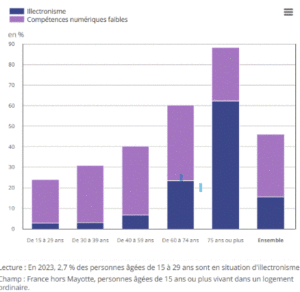
Figure 1. Proportion of the population in France experiencing digital illiteracy or possessing limited digital skills, by age group, 2023 (Insee)
Fabien de Castilla, a seasoned social entrepreneur, leads Konexio Africa, the regional branch of the international digital inclusion organization. His career began in the private sector, later evolving toward social impact. As Development Director at Groupe ARES, a French social enterprise that supports people excluded from the labour market, de Castilla focused on inclusion through employment and training. His path then turned toward Africa, where he met Konexio’s founder, Jean Guo. Together, they set out to expand Konexio’s training programmes to Kenya, Uganda, and Malawi.
From Humanitarian Aid to Digital Resilience
Building on Konexio’s global mission, Konexio Africa focuses on supporting refugee and marginalized communities through practical digital education and access to online employment opportunities. “What makes our model effective is combining social purpose with business logic,” explains de Castilla. “Without engagement from companies, programs risk remaining disconnected from real employment opportunities.” This approach forms the basis of the organization’s Digital Inclusion Programme (DIP), a six-month course that extends beyond basic computer literacy. The curriculum includes data analysis, the use of AI tools, digital communication, and soft skills such as professional self-presentation and preparation for remote work.
Since its pilot in Malawi’s Dzaleka Refugee Camp in 2019, Konexio Africa has expanded its activities across the region. As Fabien de Castilla pointed out, in 2022, a partnership with the Jesuit Refugee Service (JRS) launched a cohort with a majority of women in Kenya’s Kakuma Refugee Camp and Nairobi’s Kibera district. Among the more than 200 participants who completed the program, 84% reported an increase in income by the end of the course, suggesting a positive outcome associated with the training.
The Imperative of Advanced Digital Skills
The expansion came at a pivotal moment for the continent’s digital transformation. Africa’s digital economy is projected to contribute $180 billion (5.2% of GDP) by 2025, potentially rising to $712 billion (8.5% of GDP) by 2050.
As de Castilla mentioned, this growth is fueled by increasing internet access. While growth has occurred, a significant digital skills gap persists. By 2030, over 230 million jobs in Sub-Saharan Africa will require digital competencies, particularly in sectors such as Business Process Outsourcing (BPO). Currently, around one million Africans work in BPO, roughly 2% of the global workforce. The industry is projected to grow 14% annually between 2023 and 2028, nearly double the global average. Kenya is a leading player, expected to grow 19%, with government plans to create one million jobs over five years, supported by tax incentives and subsidies.
Despite this momentum, notable challenges remain. Entry-level roles such as content moderation and data annotation are often characterized by high workloads, repetitive tasks, and psychological strain, as employees may be required to review large volumes of sensitive or harmful material, including violence, hate speech, or explicit content. The rapid advancement of Artificial Intelligence (AI) introduces additional considerations, with up to 40 percent of tasks in Africa’s BPO and IT-Enabled Services (ITES) sector potentially automated by 2030.
These realities highlight the importance of initiatives that focus on cultivating higher-value digital skills. According to Fabien de Castilla, programs like Konexio Africa seek to develop competencies in areas such as data analysis, artificial intelligence tools, and other advanced digital capabilities, with the goal of creating a workforce that is skilled, adaptable, and capable of critical thinking.
Kakuma: A Model for Digital Transformation
The Kakuma Refugee Camp in north-western Kenya, home to displaced people from Sudan, Somalia, and Ethiopia, exemplifies the potential of this model. Life in the camp is defined by scarcity, with many residents surviving on minimal food aid. Digital work provides a vital lifeline, allowing individuals to earn an income independent of humanitarian assistance.
Fabien de Castilla stresses that effective digital inclusion requires both connectivity and continuous learning. He points to new technologies, such as satellite-based internet, that are rapidly eliminating geographical barriers. “Recent advances by providers like Starlink are bringing high-quality internet into previously isolated regions,” he observes. “It’s now possible to have the same connection in Nairobi or a remote village as in a European capital.” Still, he cautions that connectivity is only the beginning.
“Being digitally connected is only a starting point. The real objective is enabling continuous learning and professional specialization,” de Castilla concludes.
Access to technology alone does not guarantee participation. Ongoing education and professional development opportunities are needed to enable individuals to engage effectively in the evolving digital economy.

Aela Niget-Powers
Aela is a student at ESSEC Business School and holds dual French and American citizenship. Interested in global affairs, she approaches her studies with an interdisciplinary perspective that connects political thought, culture, and the arts. Alongside her coursework, she attends evening classes at the École du Louvre to deepen her understanding of art history and its place in society. Having spent time in diverse cultural settings, Aela has developed a broad outlook that informs her academic and editorial work. Her writing aims to contribute to thoughtful discussions on the intersections between art, politics, and society.